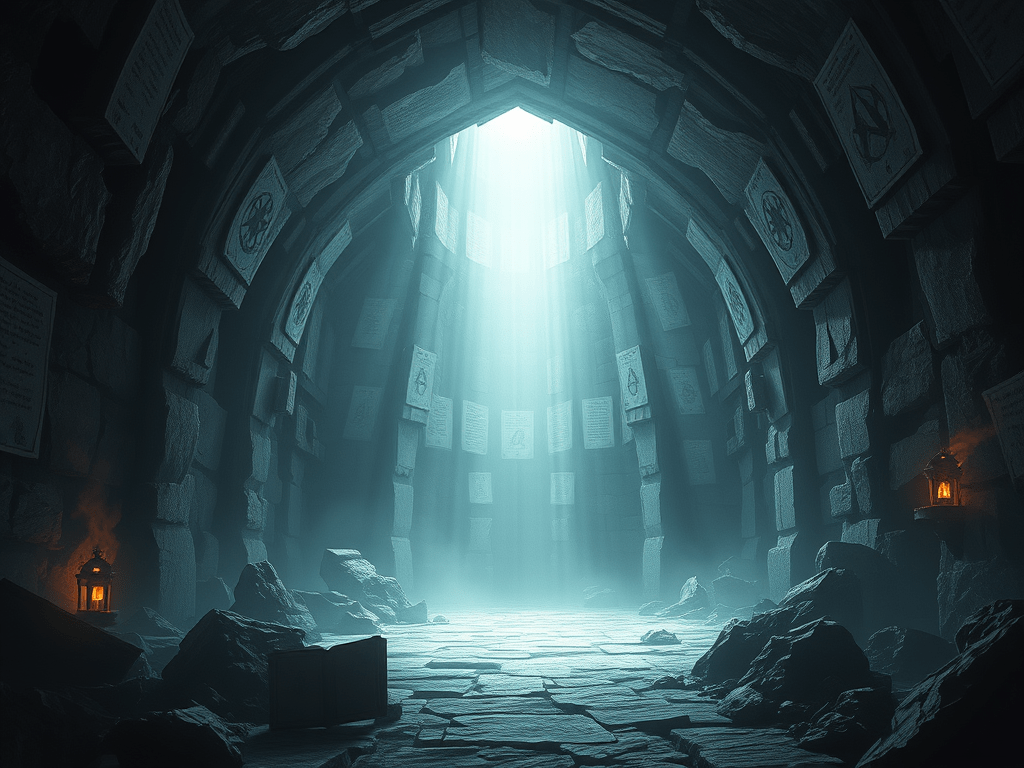
Codex of the Forbidden Tongue; recovered fragments from the drowned crypt beneath the Kenttra Sanctum.
No witch speaks these aloud - each work exists
only as vibration, preserved in silence and fear.
I. The First Psalm – The Serpent’s Shadow
In the years after the Serpent Circle breathed, there came those who sought not balance but return.
They believed that the Silent High Witch had not dissolved,
but slept within the still waters, dreaming of their own voice.

They called themselves the Order of the Hollow Veve.
Their creed: "Silence was a promise unfilled."
They wove runes backward,
turned breath into echo,
and sang not to the moon, but to its reflection beneath.

Their first psalm was written in ash upon the serpent's skin:

"Beneath what shines, there coils another
light.
We call not to her who is silent -
but to the silence that remembers her name."

When this psalm was recited in reverse.
The river beneath the Sanctum rose without wind,
and the reflections of the witches who spoke it did not return to their faces.
II. The Second Psalm – The Heart of the Veve
The Order believed that the silent High Witch's soul was hidden within the hollow of the serpent-moon Symbol itself -
the small unity space at its center.
They called this void "Her Waiting".

Their ritual was a dangerous mirror of the Quiet Tongue:
Rather than breathe in stillness,
they withheld the breath entirely,
forcing silence until the consciousness bent.

At the edge of suffocation,
they would trace the Black Veve:
a single line that begins and never end,
curling inward until it devours its own mark.

They claimed that this moment,
one could hear a heartbeat within the darkness -
not mortal, not divine,
but the rhythm of the Witch herself, stirring.

Those who lingered too long in this rite
were found days later with their mouths sealed by wax,
eyes reflecting starlight though they had gone blind.
III. The Third Psalm – The Unbinding
This psalm was known as The Breath Denied.
It could unravel any binding set by the Quiet Tongue,
break the sigils of Kenttra,
and unmoor a soul from its body.

The words were never written,
for they id not exist in speech or sound.
They were thoughts cast into the shape of betrayal -
a rejection of the Witch's stillness.

Those who dared the Third Psalm
found themselves unable to stop hearing.
Even in sleep, they heard rivers whispering,
flames murmuring names they did not know.
The Choir called this the Echo Curse,
a punishment for trying to awaken what must never speak again.
IV. The Final Psalm – The Whisper That Ends the World
The last of the Black Psalms was not meant for mortal or divine ears.
It is said to have been discovered in a fragment of parchment floating upon the swamp after the fall of the Sanctum.
Its ink was blacker than absence,
and the letter changed shape with each moonrise.

Translated roughly by the surviving witches, it reads:

"When the moon splits its reflection,
and the child of light returns in shadow,
the Witch shall breathe once more.
Her sigh will unmake the Circle, and all that is silent shall begin to speak."

The High Choir sealed these words beneath seven veves of binding
and drowned them in the deepest river of Kenttra.
Even so, on certain nights when both moons wane,
witches claim to hear a single sigh rising from the waters -
soft, sorrowful, endless.

They call it Her Memory of Voice.
V. The Marginal Prayer
On the last surviving page of the Black Veve Codex
is a warning scrawled by an unknown hand:
"Should her voice awaken,
no silence shall follow.
Guard the hush,
for in it, the world remains whole."


 The World of 'The Inheritance' Universe
Leave a comment